
The hidden costs of intermediaries and how your guests make booking decisions
Research shows that as many as 8 in 10 online bookings in Poland come through online travel agencies (OTAs). That should come as no surprise, given how accustomed we’ve become over the years to the convenience and sense of security they offer.
I’m speaking as a hotel guest, though. Things look very different from a hotelier’s perspective. OTAs make great business partners, but relying on a single channel for all your sales carries considerable risk.
At GuestSage, our team tells the sad story of a property that relied on one booking site for all its sales. For years, it ranked near the top of the site’s results and was hugely popular.
All it took was one change to the algorithm that ranked the hotel, and sales plummeted by tens of percent. Sadly, the property didn’t survive the change.
That’s hardly a reason to go to war with OTAs. They do a great job of marketing your hotel and extending your reach worldwide. The key, though, is balance. Your aim should be to find a healthy mix that lets you benefit from OTAs while attracting more and more direct bookings.
One way to achieve that is to offer a best rate guarantee. Why does it work, how does it work in practice, and how can you try it at your own hotel? That’s what I’ll cover in today’s article. Let’s dive in!
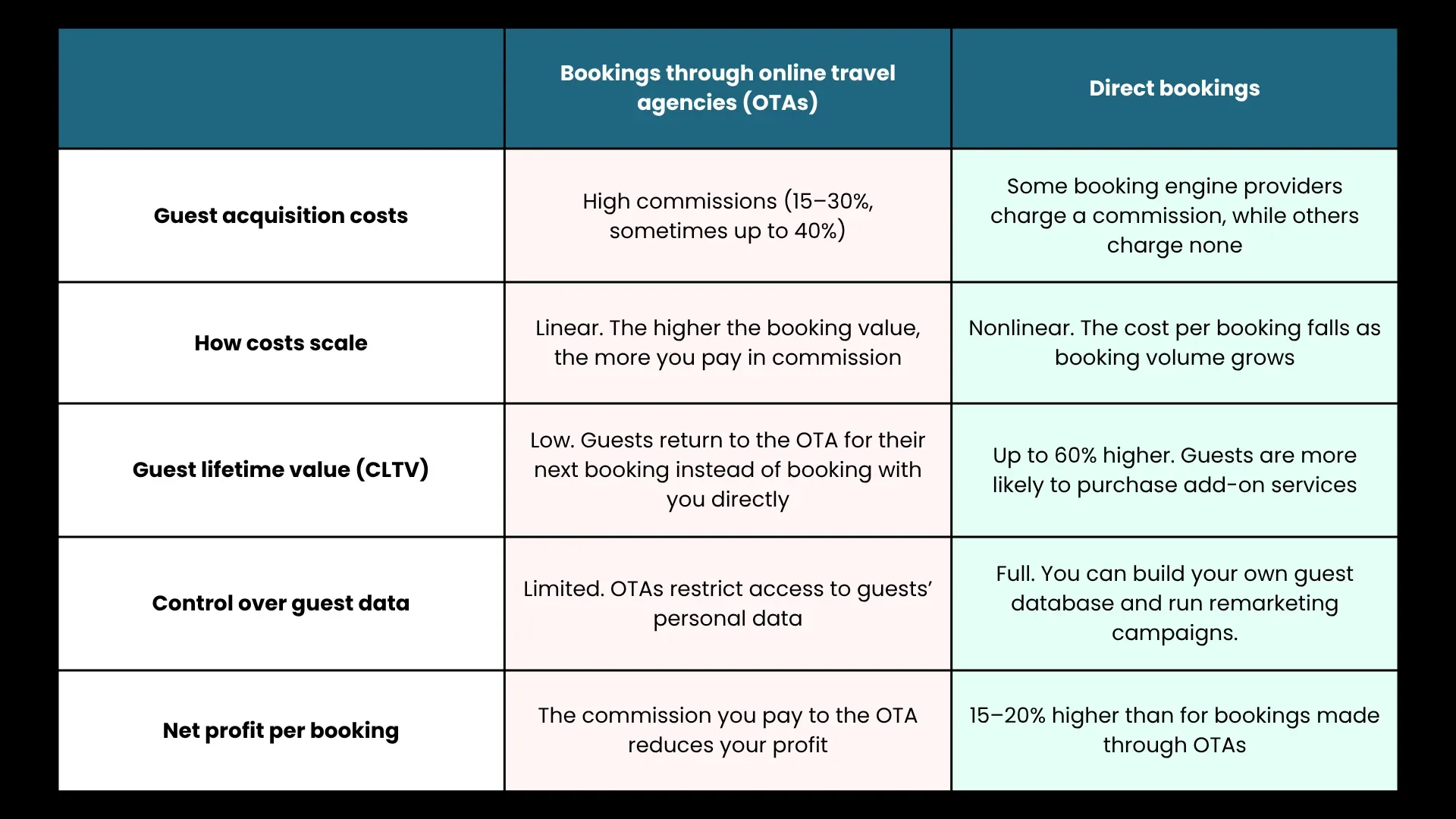
Working with OTAs comes at a cost that often creeps up unnoticed. The traditional 15% commission is a rarity these days. In 2026, the actual cost of acquiring a guest through an intermediary ranges from 15% to 30%.
The main problem with OTA commissions is that they rise in direct proportion to your revenue. When you raise your room rate, you pay the intermediary proportionally more. Direct marketing costs work quite differently. Although direct marketing requires some upfront investment, the cost of acquiring a guest this way steadily falls over time.
Why are guests so keen to use booking sites? The answer lies in their shopping habits. More than half of travellers start their search there.
Yet the latest research reveals a striking trend. As many as 75% of people who end up booking directly have already viewed your hotel on an OTA. We call this the billboard effect.
Guests find your hotel on a booking site, then head to your website. They’re looking for more information, a feel for what makes your hotel special, or simply a better deal.
If they find confusing prices or a complicated booking process on your site, they’ll head straight back to the intermediary. The goal is clear: keep them on your site. I don’t want to repeat what we’ve already covered in our guides, though. Instead, here’s a short reading list:
15 serious booking engine mistakes that cost you reservations - part one and part two
How to set up your booking engine to sell more - read the guide
Mobile UX in hospitality. How your mobile website affects direct bookings - read the guide
How the EU’s digital markets act put you back in control
Remember when booking sites used to prohibit you from offering lower rates on your own website? Thankfully, those restrictions are a thing of the past. The EU’s Digital Markets Act (DMA) brought about a change Polish hoteliers had been waiting years for.
EU law imposed an outright ban on booking sites using rate parity clauses. You’re now entirely free to offer better rates and more favourable cancellation terms directly on your own website, and it’s perfectly legal to do so.
What’s more, intermediaries cannot penalise you in any way for doing this or push your hotel down in the search results. Now that we’ve regained that freedom, let’s turn to the best rate guarantee.
The best rate guarantee on paper…
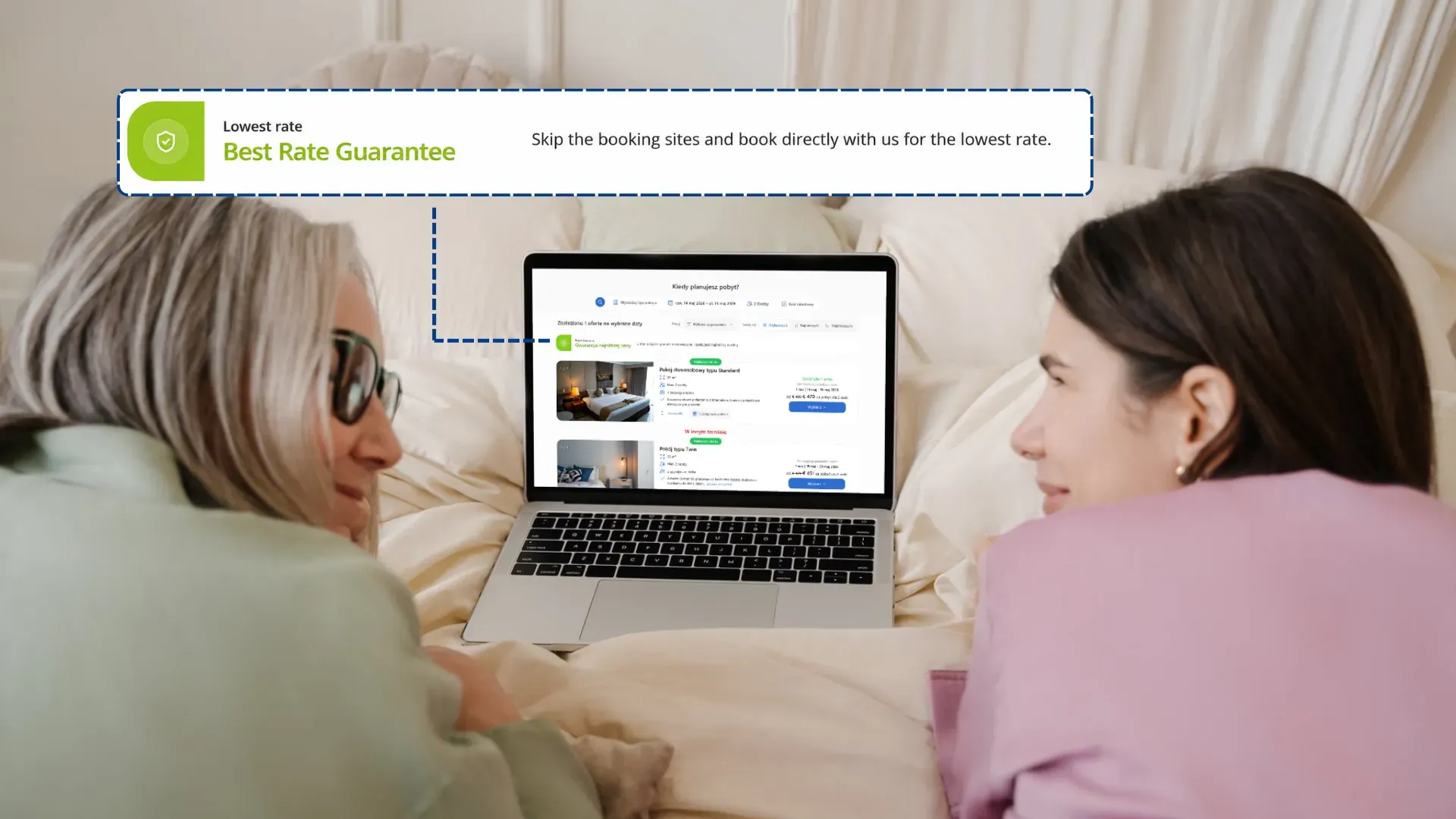
A best rate guarantee is a simple promise to your guests: you’ll find the best deal for your stay right here on the hotel’s website. It sounds simple, but delivering on it can be much harder in practice.
On the one hand, nothing happens on a booking site without the hotelier’s knowledge. On the other, problems arise when several discounts apply at once: the Genius programme, mobile discounts, seasonal promotions or location-based pricing rules. When that happens, making sure the final rate on the booking site never drops below the one on your hotel’s website becomes a real challenge.
Some hoteliers spend hours poring over spreadsheets and calculating what the final rates will be once all promotions are applied. In our experience, even people who keep a close eye on rate parity can be surprised to find an OTA showing a lower rate.
All it takes is an overlooked rule for inheriting rates, an accidental settings override or one active promotion that’s easy to forget. The guest then sees a lower rate on the booking site than on the hotel’s official website. You can hardly blame them for choosing the cheaper option, can you?
The trouble is, you lose out twice. First, you give up part of your revenue in commission. Second, you reinforce the guest’s belief that the hotel’s website isn’t the place to look for the best deal.
If you’ve managed to keep your rates fully consistent across all your sales channels, congratulations! For most properties, though, it’s a daily challenge. We rarely review a client’s rate parity report without finding at least one date when a booking site shows a better rate than the hotel’s official website.
That’s why we decided to build a best rate guarantee… right into our AI Booking Engine.
…and in practice
Our Best Rate Guarantee module compares the rates available through your direct channel with those guests see on third-party sites and makes sure the offer on your hotel’s website is just as attractive, or even better.
The system checks rates for specific rooms and dates. If a lower rate appears on a booking site, we automatically adjust the rate in your booking engine. You can, of course, choose whether the booking engine should match the OTA rate or beat it by a set amount, such as 3% or 5%.
The benefits don’t end there
Do you know why guests often leave hotel websites without booking? Often, there’s no room available on their preferred dates, or a minimum-stay restriction applies (for example, a three-night minimum).
The Offer Recommender module built into AI Booking Engine addresses this problem. Instead of showing an empty page that says “No rooms available”, we automatically suggest alternative dates or flexible stay options.
If your hotel operates seasonally, the system will show guests Christmas or New Year’s Eve packages well in advance, even if they’re looking for a summer weekend stay. The Price Personalizer algorithm works hand in hand with Offer Recommender. It lets our AI tailor the offer to each visitor. Using cookies, past bookings or a simple Google sign-in, we build a profile of the guest’s behaviour.
If the algorithm detects that a guest previously booked through an OTA, we’ll offer them a personalised discount to encourage them to book directly. Crucially, AI Booking Engine adjusts discounts as occupancy changes. During the low season, when you have rooms to fill, it will automatically offer a larger discount to attract a guest. In peak season, it will block discounts to protect your higher revenue.
See the best rate guarantee in action
If today’s article has you thinking about strengthening your direct booking channel, we have a tempting offer for you. Join us for a demo of our AI Booking Engine with Best Rate Guarantee enabled.
Our adviser will be happy to answer all your questions and show you how AI Booking Engine would fit into the day-to-day running of your hotel.
Thanks for staying through the end credits, and have a wonderful day!