Many hoteliers invest in a new website and booking engine expecting an immediate increase in direct sales. In practice, however, implementing new solutions does not automatically translate into better sales performance.
Most often, the issue does not lie in the technology itself but in incorrect configuration. Poorly named room types, disorganized rate plans, missing descriptions, incomplete language versions, or incorrectly configured cancellation and payment policies can significantly reduce conversion rates - even when the booking engine is technically functioning without any issues.
In this article, based on our experience working with hoteliers, we will show you step by step how to prepare your booking engine for effective direct sales.
All examples and recommendations refer to the daily use of the AI Booking Engine by GuestSage. However, the knowledge presented here is universal enough to be successfully applied to other booking engines available on the market as well.
1. Hotel and room names - the foundation of offer visibility
First impressions start with the name
The first elements a guest sees after entering a booking engine are the property name and the names of the available room types. These elements shape the first impression and help organize the offer in the user’s mind. Although this may seem obvious, in practice this is exactly where a surprising number of mistakes occur - mistakes that later make the sales process more difficult.
Where the booking engine pulls room names from
In the GuestSage booking engine, the hotel name and room names are pulled directly from the data configured in the extranet. If random information, technical abbreviations, room numbers, or internal labels used only by staff are entered there, those exact names will be displayed to the guest on the website. Instead of a clear and attractive offer, the result is informational chaos.
Room names should support sales
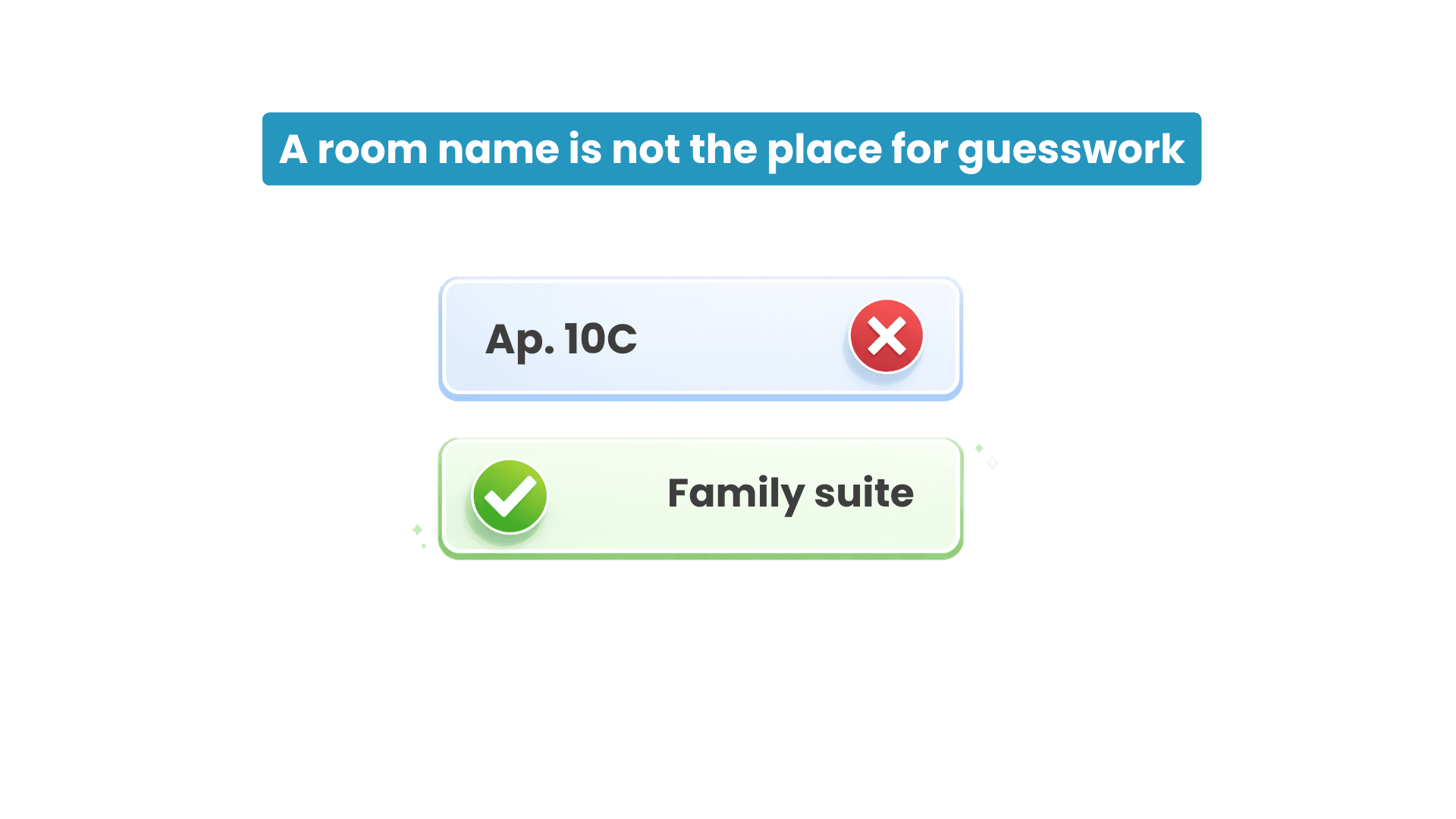
A good room name should clearly communicate the room category and the key feature that differentiates it from other options. Names such as “Standard Double Room,” “Superior Room with Balcony,” or “Family Suite” are intuitive and help guests quickly identify the option that best fits their needs.
Names like “Room 10C,” “New 2,” or random internal abbreviations provide no value from the customer’s perspective and only make the decision-making process longer and more confusing.
Property name? Only official information
In the property name field in the extranet, you should include only the hotel’s official name. Adding extra company details, such as tax identification numbers, marketing slogans, or service descriptions, causes the booking engine to display this information in a disorganized way, which lowers the overall professional appearance of the website.
Consistent and well-structured naming has a direct impact on the clarity of the offer. Guests can more easily understand the structure of available room types, compare options faster, and move more smoothly to the next stage of the booking process.
2. Room descriptions - helping guests make a decision
The most common mistake - missing content
Many hoteliers leave the description field empty or add just a single sentence with little informational value. In such cases, the booking engine displays only the room name and a list of amenities. That is not enough to create a clear picture of the space or to convince a guest to choose that particular option.
The description does not have to be long, but it should answer the key questions that naturally arise in the guest’s mind.
What should a good room description include?
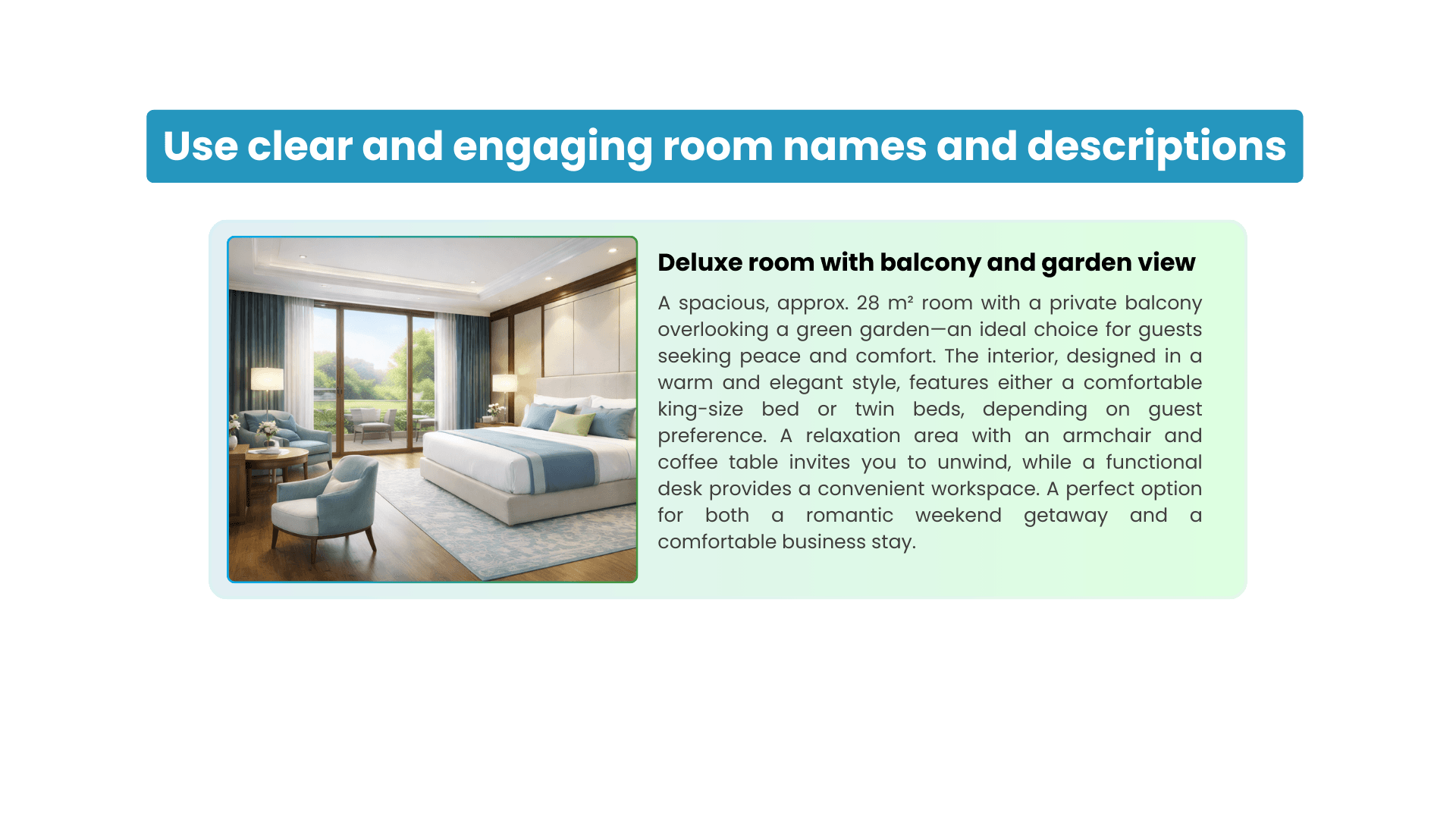
An effective room description focuses on what actually matters to the guest:
- the layout and size of the room
- the type of beds
- the style and character of the interior
- distinctive amenities that make the room stand out
- information relevant to a specific group of guests (e.g., families, couples, or business travelers)
There is no need to repeat the full technical list of amenities here, as this information is already displayed in a separate section of the booking engine.
Language that sells the experience
A good description is not a dry technical specification. It should be written in simple, natural language that helps the guest imagine their stay. A few well-chosen sentences can encourage a booking far more effectively than the longest bullet-point list.
It is also important to maintain a consistent style across all descriptions. This makes the offer look more professional and well-structured.
Don’t overlook international guests
The AI Booking Engine by GuestSage allows content to be automatically translated into other languages. However, for this feature to work correctly, the primary description must first be completed in the property’s main language. If there is no content, there is nothing to translate - which directly limits the availability of the offer for international guests.
Completing the descriptions in one base language is enough for the system to generate a clear version for guests from different countries.
In our booking engine, room descriptions are edited directly in the extranet within the room standards section. After saving any changes, it is always worth checking how the description appears on the website - exactly as a potential guest will see it.

3. Rate plans
Where confusion most often begins
Rate plans are the element of a booking engine that directly determines how the offer is presented to the guest. This is also where we most often encounter disorganized naming, random descriptions, and a lack of consistent structure. As a result, the offer becomes difficult to understand already at the stage of selecting a room.
The rate plan name should clearly communicate the booking conditions
A rate plan should immediately answer the guest’s basic question: under what conditions am I making this reservation?
That is why the most effective rate plan names clearly indicate:
- the cancellation policy,
- whether breakfast is included,
- the payment terms.
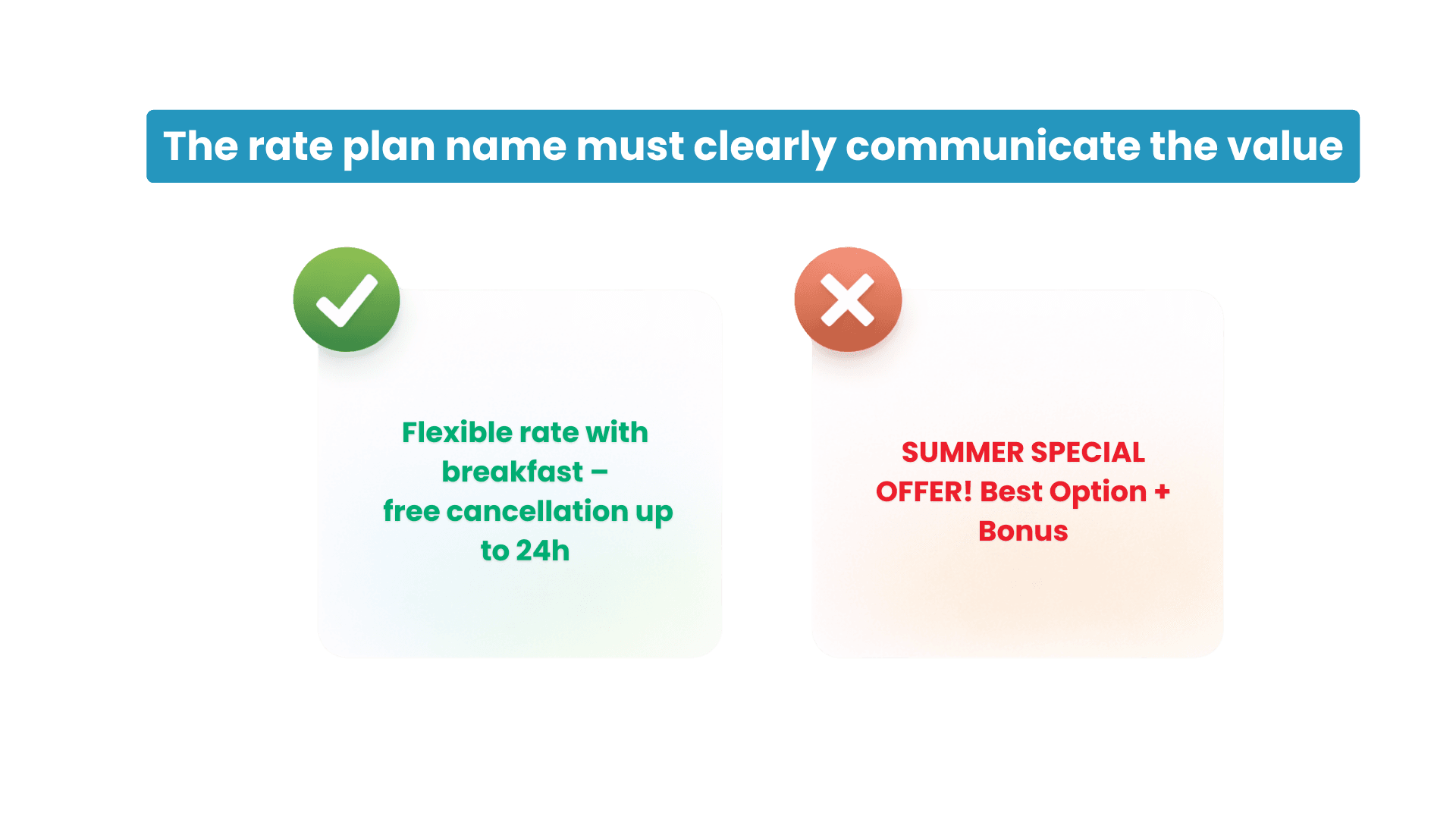
Using simple and repeatable structures - such as Flexible, Semi-Flexible, and Non-Refundable offers, with breakfast clearly indicated - helps organize the offer and makes it easier for guests to compare the available options.
4. Payment and cancellation policies
The most common mistake - a name without actual configuration
A frequent issue is creating a cancellation or payment policy by assigning it only a name, without configuring the actual terms. In such cases, the booking engine has no rules to operate on. As a result, the offer may appear as non-refundable, even if the property intended to provide flexible conditions.
At least two policies as a standard
As a best practice, every property should have at least two policy variants configured:
- a Flexible policy,
- a Non-refundable policy.
Consistency with sales conditions and competitiveness
The conditions defined in the policies must be consistent with the actual rules applied by the property. Any discrepancy between the declared and the real policy may lead to misunderstandings and guest complaints.
It is also important to check what policies are offered across other distribution channels. For example, if you offer a flexible policy on OTAs, but only a non-refundable option on your hotel website, your own direct offer immediately becomes less attractive to potential guests.
5. Discounts and access codes as a real incentive for direct bookings
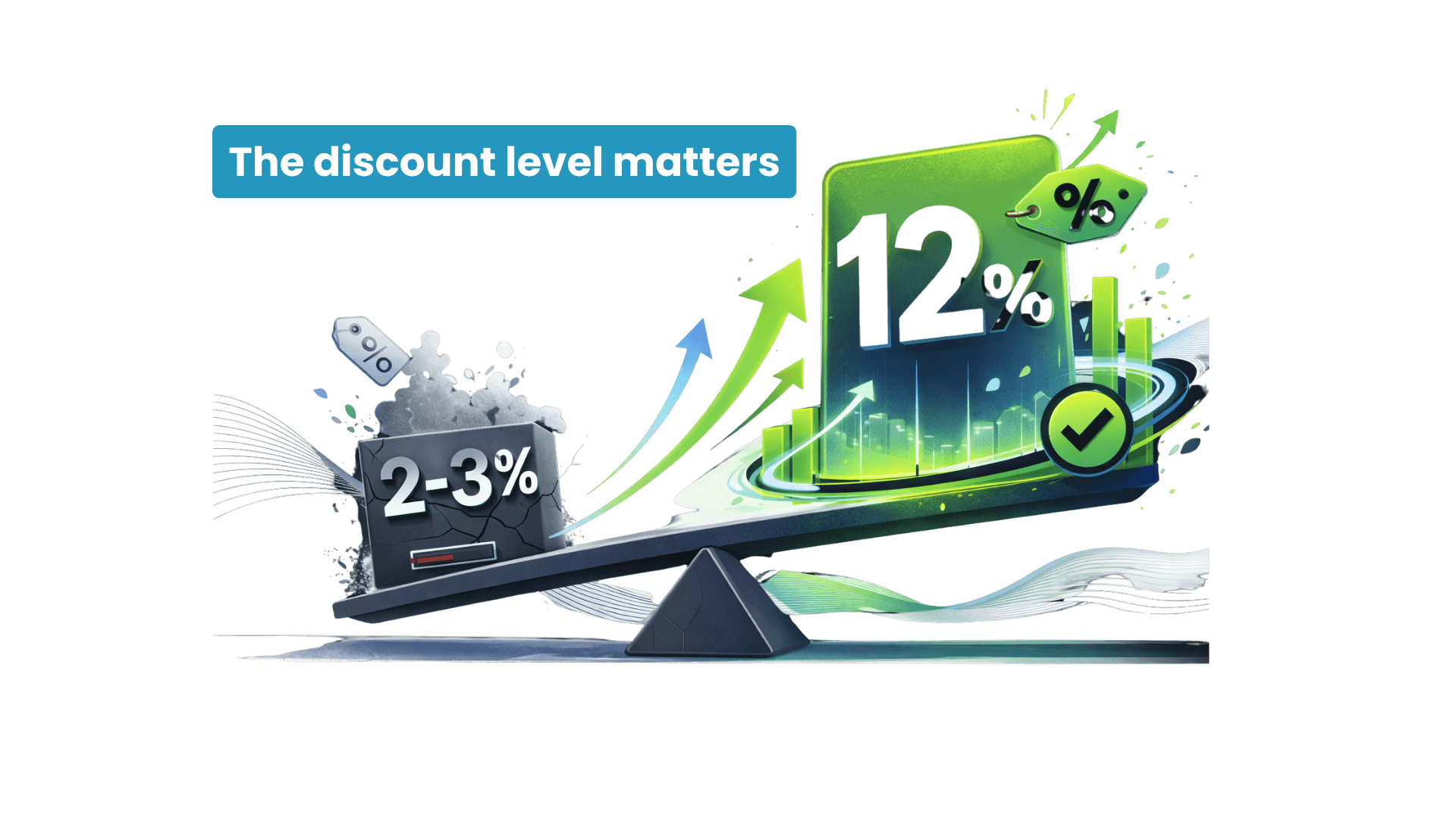
Symbolic discounts don’t influence booking decisions
A 1–2% discount is practically unnoticeable to most guests. Such a small difference does not create a competitive advantage and rarely affects the purchasing decision. In practice, a discount should be at least 5%, and in the case of short stays or highly competitive markets, even 7–10% to be truly noticeable during the offer comparison stage.
This is particularly important because large booking platforms such as Booking.com already offer guests discounts through mobile login deals or the Genius loyalty program. These discounts usually start at 10%, and in some cases can reach 15–20% for more active users on selected offers.
Mobile discounts
Bookings made on mobile devices often occur at the final stage of planning a stay. A dedicated mobile discount of 5–10% can effectively capture the guest’s attention and increase the likelihood that the booking will be completed directly on the hotel’s website.
Access codes for returning guests
A booking engine also allows you to create discount codes that can be shared with returning guests via email communication or at the front desk. These codes should be simple, clear, and linked to a specific benefit. Examples include:
POWROT5 - 5% discount on the next reservation
LOYAL10 - 10% discount for loyal guests
SUMMER8 - 8% discount for seasonal stays
This is a simple and effective way to build guest loyalty and encourage repeat bookings without intermediaries.
6. Occupancy-based pricing - a detail that can distort your offer
Complete pricing formulas
In a booking engine, the room price should adjust to the number of guests. If you do not complete all pricing formulas, the system will display the same price regardless of the number of guests. As a result, the offer may appear unfavorable or illogical from the customer’s perspective.
Missing pricing configurations can also make the direct offer look less attractive than the one presented in other distribution channels. Guests may see an incomplete or unclear pricing structure, which can reduce their trust in the transparency of the offer.
Completing prices for each possible occupancy level in the room does not require much effort, yet it has a direct impact on how the offer is perceived. Guests can immediately understand how much they will pay for their stay, regardless of the number of people in the reservation.
Booking engine configuration checklist
Key elements to verify
Before launching or evaluating the effectiveness of your booking engine, make sure the following elements are properly completed and consistent with one another:
- the property name and room names are clear and understandable for guests
- each room has a short, informative description
- rate plans follow clear and logical naming conventions
- rate plan descriptions clearly explain the booking conditions
- cancellation and payment policies are not only named but also properly configured
- at least two policies are available: Flexible and Non-refundable
- the direct offer is competitive compared to booking platforms
- discounts provide a noticeable and meaningful benefit
- mobile discounts and/or codes for returning guests are configured
- prices are defined for every possible occupancy level in the room
- base content is prepared for automatic translations
Most of the elements described above require only a few minutes of work in the extranet. Despite this, they have a direct impact on whether the guest understands the offer, trusts the hotel’s website, and ultimately decides to make a direct booking.